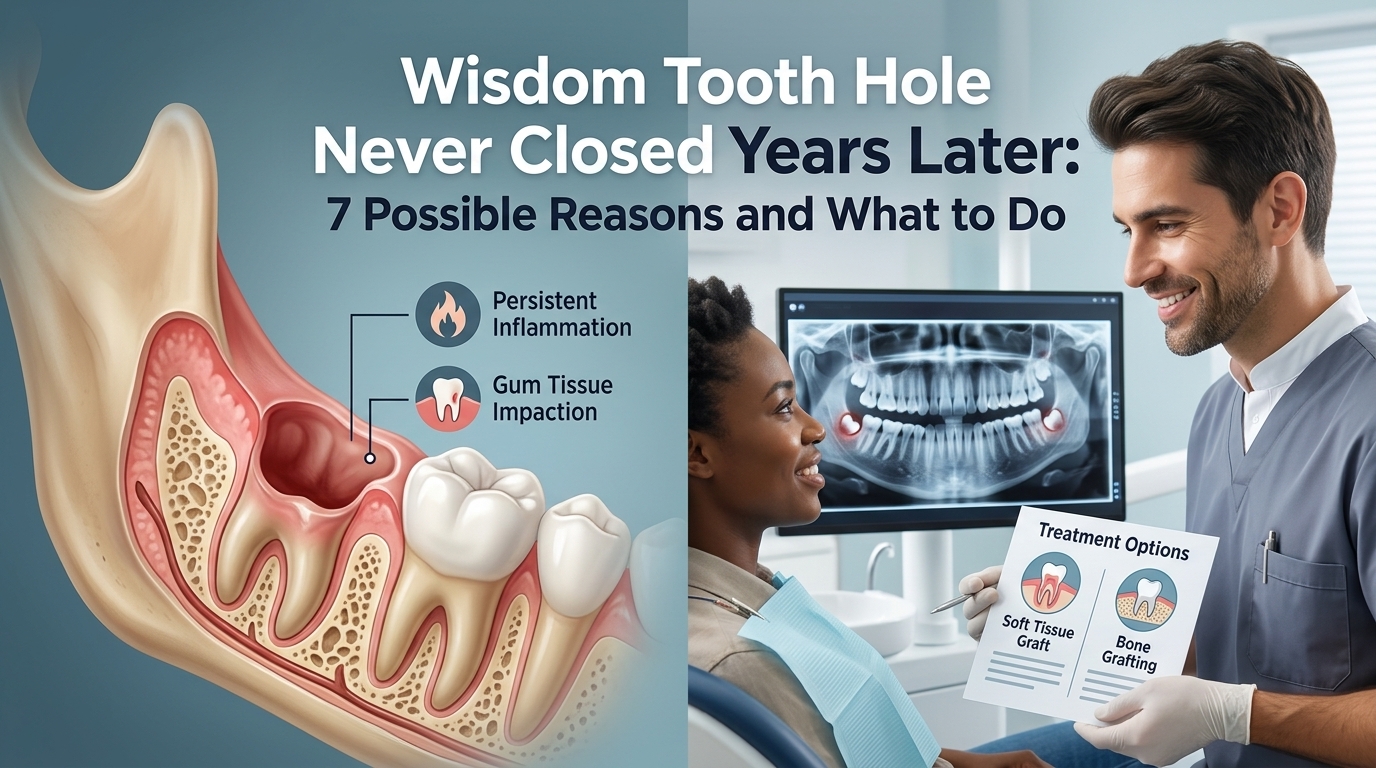
As many as a decade or more later, you reach the back of your mouth with your tongue in the course of a routine cleaning and feel a hole where your wisdom tooth should be. If the food catches there or it hurts off and on, it can be really quite alarming. The search “wisdom tooth hole never closed years later” often reflects one basic concern: Was the extraction site supposed to disappear completely?
Usually, the answer is more complicated than simply yes or no.
The extraction gap begins to heal with new bone-like tissue and the gum grows to close it in the first few months post extraction. Even after the socket is filled, the bone remodeling in the surrounding area takes a year or longer and the result is not always flat – there might still be slight contour differences and indentations.
However, if you are concerned that a wisdom tooth hole never closed years later, a genuinely persistent opening accompanied by recurrent swelling, bleeding, a bad taste, drainage, or pain is different from normal healing. If you notice these symptoms, it may be a smart idea to visit your dentist for an examination, rather than brushing it off as a normal part of healing after an extraction. It begins with a simple explanation of what occurs under the gums once wisdom teeth removal is complete.
What Happens to a Wisdom Tooth Socket After Extraction?
When a wisdom tooth is removed, the tooth leaves behind a socket in the jawbone. If you are wondering whether a wisdom tooth hole never closed years later, it helps to understand that the socket initially contains a blood clot that protects the underlying bone and nerves while supporting early healing.A new tissue begins to grow at the bottom of socket and the gum will soon close the opening above that new tissue. Gum healing is not necessarily happening at the exact same time as bone healing. One may seem completely healed at a glance when there is significant reconstruction going on below.
That is also a major difference and explains why one may still feel a dip long after the extraction without an unhealthy, nonhealed wound.
The Cleveland Clinic adds that extraction sites are healed from bottom to top and they will often have a small indent as new tissue forms, which is part of the normal wisdom tooth extraction healing process. Lower third-molar extraction sites are located at the very back of the jaw and this combination of jaw shape, and gum structure often makes a small dip seem very deep
Does a healed extraction site have to become completely flat?
No.
A completely smooth gum surface is not required for an extraction site to be healthy. If you are wondering whether a wisdom tooth hole never closed years later, keep in mind that the gum can remodel into a slightly recessed or uneven shape after extraction. For some people, the shape of the surface in question simply renders it a place that collects small bits of food more easily.
What matters most is how the area looks and feels now, not just whether you see a definite notch. A smooth-edged, pain-free depression in the surface of the area that has appeared pretty much unchanged for years is distinct from one that is new, painful, swollen, or oozes freely.
Why a Wisdom Tooth Hole May Seem Open Years Later
Several explanations can account for the sensation of a persistent hole. They range from a harmless anatomical depression to a dental problem that needs treatment.
1. The gum healed but left an indentation
One of the simplest explanations is that the extraction site healed but did not return to the exact contour it had before the tooth was removed.
The healing process does not necessarily perfectly recreate the original anatomy. The socket will slowly begin to fill with tissue and bone but the surface may not return to exactly flush; you may have a slightly sunken area. This will more than likely occur where extraction was complicated, or a wisdom tooth was impacted and required a relatively significant operation to remove. In the absence of pain, swelling, or any change to the area over an extended period, you may simply be feeling the indent that has remained following healed extraction.
2. The socket is trapping food
A recessed extraction site can sometimes become a small food trap.
This can be particularly frustrating when food repeatedly collects in the same area. For someone wondering whether a wisdom tooth hole never closed years later, noticing particles come out after rinsing may create the impression that the socket is still an open surgical wound, even when the gum has actually healed into a recessed or uneven shape.
This trapped food or debris could annoy the gum around the hole, or create inflammation. Cleveland Clinic lists it: ”The patient’s tongue gets into wisdom-teeth area to chew this trapped, sometimes decomposing food bits which makes your mouth unhealthy.”
3. A small bone fragment may be working its way out
What may feel like an indentation may actually be a hard or sharp point of bone that lies under or just along the gums. From Royal Cornwall Hospitals’ notes for patients: a small piece of bone that may come to sit on, or near, the surface may be revealed with time following removal and gradually dissolve or work its way through. Bone at the site should heal without presenting as such, but there can be occurrences of small bits of bone may present over or near the site and naturally dissolve away.
You may see small sharp bits around a site, for example that will resorb over time, and should leave it to do that.
When is a sharp point a cause of concern?
A hard, sharp point on its own doesn’t necessarily represent a failed to heal extraction.
4. The original extraction was complicated
Not every wisdom tooth requires the same kind of treatment. If your wisdom tooth came in normally, removal may be relatively simple. If, however, you are going to have your wisdom tooth extracted from the socket because it is impacted, a portion of the surrounding bone may need to be surgically removed, or the tooth may be divided into pieces after the tooth socket is accessed via the incision in your gums.
The greater the complexity of the procedure involved, the bigger the resulting initial surgical lesion.
Cleveland Clinic states that impacted wisdom teeth may result in incision and division of tooth on oral cavity. These are to access wisdom teeth within alveolus and to perform their removal. Complex wisdom teeth should not become an openwound, however, that will remains for a period of years – they are simply shaped differently.
Could It Still Be Dry Socket Years Later?
This is one of the most common misconceptions.
A hole that remains years after wisdom tooth extraction is extremely unlikely to be a dry socket.
Dry socket-which is known medically as alveolar osteitis-is an early complication that typically develops shortly after tooth extraction. This means that the blood clot that covers and protects the tooth extraction site is disturbed, lost, or does not form correctly. This uncovers and irritates nerves and bone, creating a severe pain.
This condition is a relatively short-term problem, not a problem that appears after years. According to Cleveland Clinic, dry socket can appear within three days of an extraction; according to another clinical reference, the normal time for it to appear is three to five days after an extraction.
The American Dental Association is in agreement that dry socket is a condition that develops after an extraction in which a blood clot becomes dislodged, causing pain as exposed nerves and bone are irritated.
Thus, saying “dry socket” to describe a small indentation discovered years after wisdom tooth removal is most likely an mislabeling of the condition.
The difference is important because the appropriate course of assessment for a long-standing dental hole would be different from the treatment that is suggested for this immediate postoperative problem.
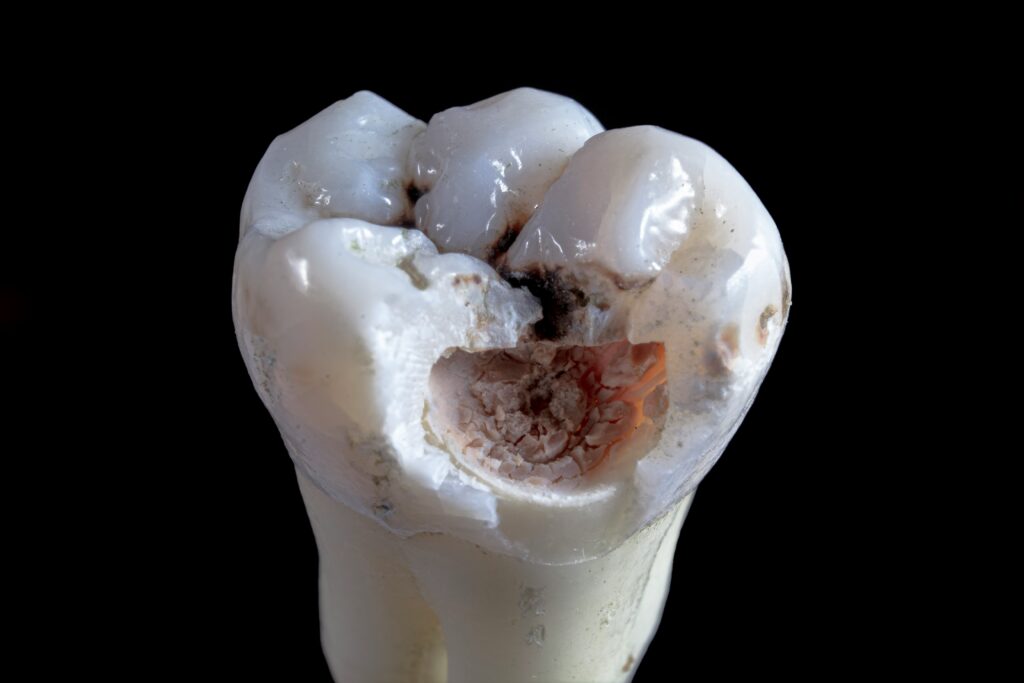
When a Persistent Hole Could Signal a Dental Problem
A persistent indentation by itself is not necessarily alarming. Symptoms accompanying it are much more informative.
Pain or tenderness
Pain that appears years after an extraction deserves attention, especially if it is new or progressively worsening.
The dentist may need to determine whether the discomfort is actually coming from the old extraction site or from a nearby tooth, gum, jaw joint, or other structure.
Swelling
Swelling around the area can indicate inflammation or infection. It is particularly concerning if it repeatedly appears and disappears.
Bad taste or drainage
A persistent unpleasant taste, pus, or fluid coming from the area should not be dismissed as ordinary food trapping.
The NHS advises seeking dental care for pain accompanied by a bad taste, fever, or feeling unwell following wisdom tooth removal.
Although those recommendations are particularly relevant to postoperative problems, similar symptoms occurring long after surgery still warrant professional evaluation.
Bleeding
Occasional minor bleeding from irritated gum tissue can have many causes, but unexplained or recurrent bleeding from an old extraction site should be checked.
Increasing size or a new opening
A site that has been stable for years but suddenly seems deeper or more open deserves examination.
A dentist may need to determine whether the change represents gum disease, local trauma, an infection, a cystic process, or another condition unrelated to the original extraction.
Could a Tooth Fragment Be Left Behind?
Patients are sometimes concerned that part of the wisdom tooth was left behind inside the jaw bone. Fragmented roots are a potential issue after complex extractions, and the consequences of retention are varied. Dental images are often needed to differentiate between a root remnant or a piece of tooth versus other structures, such as a bone fragment.
“It is impossible to tell what is under the gum by feeling with the tongue and finger,” states the American Association of Oral and Maxillofacial Surgeons.
An X-ray is a much better way for the dentist to visualize not only the jaw bone underneath but other surrounding tissues. Imaging can be a tool in assessing problems that arises from extractions, such as identifying root fragments when needed, Cleveland Clinic points out.
Could the Problem Actually Be From a Nearby Tooth?
This possibility is easy to overlook.
The second molar sits directly in front of the lower wisdom tooth area, so problems with that tooth can sometimes feel as though they are coming from the old extraction site. If you are concerned that a wisdom tooth hole never closed years later, it is worth considering other causes, such as tooth decay, a cracked tooth, gum disease, or another dental problem affecting the nearby second molar.
This is the same with the upper part of the wisdom tooth region, where the relevant anatomy is connected tightly with neighboring tooth roots and the sinus cavity. Accordingly a dentist should consider the entire area before deciding that a toothache is due to the extraction site.
How a Dentist Evaluates a Hole That Has Lasted Years
The evaluation usually starts with something surprisingly simple: looking carefully at the area.
The dentist may examine the gum, check whether food is becoming trapped, assess tenderness, and inspect the neighboring teeth.
If the appearance or symptoms warrant further investigation, dental X-rays can help reveal structures that cannot be seen through the gum.
Depending on the situation, the dentist may be looking for:
- retained tooth or root fragments
- changes in the surrounding bone
- infection
- gum disease
- a cyst or other lesion
- problems involving a neighboring tooth
- an unusual anatomical depression
The appropriate test depends on what the examination shows. Not every persistent indentation requires advanced imaging.
What You Can Do at Home
In the absence of pain and swelling, drainages and other signs of disease, a healthy dimple/stable hollow in itself can very be managed appropriately by observing the above points that would include maintaining oral cleanliness around,not over stimulating the area by pricking it repeatedly with your finger, toothpicks or etc as the mechanical stimulation to already depressed area in the gum can prove detrimental. Inquire with your dentist or dental hygienist the appropriate method to keep it clean if the food gets caught in between as there is more then adequate one method depending upon the location and depth of site. Do not probe into to dig out either a presumed bony or toothy part yourself.
When Should You See a Dentist?
It is important to see your dentist if the tooth extraction site has recently become: painfully inflamed tender swollen has a bad taste or smell continuously bleeds continuously is oozing pus or drainage the patient has an elevated body temperature or there has been a recent, marked difference in the area has there was increase mouth opening difficulty The symptoms of severe, unchecked infection include swelling of any extremity, difficulty breathing, and difficulty with swallowing, and this medical emergency dictates the immediate removal of the person to a medical dentist.
For patients who just see that the site of the extraction has a depressed indentation, or other minor defect, that is otherwise without a sense. This is nothing. The dental examination at these events of minor dental examination and dental examination should reassure.
A More Useful Way to Think About the “Hole”
The phrase “my wisdom tooth hole never closed” can make it sound as though the mouth has been stuck in the immediate aftermath of surgery.
That is not necessarily what is happening.
An extraction socket is a wound in bone, and healing involves several stages. The gum closes, new tissue develops, and the underlying bone remodels. The final anatomy may leave a subtle depression rather than a perfectly level surface.
The real question, therefore, is not simply “Can I still feel a hole?”
It is:
“Is this a stable, healed indentation, or is there evidence that something is wrong?”
Pain, swelling, drainage, bleeding, progressive change, or repeated inflammation shifts the situation toward the second possibility and makes an examination worthwhile.
Why years matter
Timeliness yields valuable diagnostic clues. The timing of the problem’s emergence distinguishes it. For example, a complication that starts soon after surgical removal is unlikely to be responsible for problems that manifest a decade or so later.
A problem appearing five years after surgery is typically unrelated to anything that happened around the time of extraction, such asdry socket, which is an early complication that would no longer explain the persistent, even new, issue.
Similarly, an indentation that seems stable is most likely simply what final gum and bone anatomy looks like; it would not explain how symptoms develop suddenly. That’s why the timing of your symptoms is one of the most important details to share with your dentist.
Conclusion
If you have searched for wisdom tooth hole never closed years later, the sight or sensation of an opening does not automatically mean your extraction failed to heal. A healed wisdom tooth socket can leave a small indentation, and that depression may occasionally collect food. The underlying jawbone also continues to remodel after the gum has healed.
Another thing that could be of significance-and thus warrant a look-is an area that is sore, swollen, bleeding, oozing, causes a bad taste at the back of the mouth constantly, or an area that is now different where prior to now, over years of stability, that has never happened. Any of these could suggest a problem with either the extraction site, a adjacent tooth, the gums, or another anatomical structure on the posterior oral cavity.
Your dentist can evaluate the problem with visual and digital imaging (as needed).
The moral of this is that an indentation in the tissue, either visible or palpable, is not the same thing as an open wound. If it is a stable area and presents with no symptoms, it may just be normal anatomy after an extraction. If things are changed from how they appeared prior to now, examination is the prudent action of choice rather than guessing.
Frequently Asked Questions
1. Can a wisdom tooth hole stay open for years?
A completely open surgical wound should not remain unchanged for years. However, the healed extraction site can retain a noticeable depression or groove. If the area appears genuinely open or is associated with pain, swelling, drainage, or bleeding, a dentist should examine it.
2. Why does food keep getting stuck in my old wisdom tooth hole?
A healed extraction site may have a recessed shape that allows food particles to collect, similar to other common dental problems that can affect the gums and teeth. The same problem can also occur around neighboring teeth or gum pockets. If food trapping is frequent or causes irritation and bad breath, ask a dentist to assess the area.
3. Can dry socket happen years after wisdom tooth removal?
No. Dry socket is an early extraction complication that typically develops within several days after tooth removal. It does not explain a new hole or pain that begins years later.
4. Is it normal to have a small indentation after wisdom tooth extraction?
Yes, a small indentation can remain after the extraction site heals. The socket fills with new tissue and the jawbone remodels, but the final gum contour does not necessarily become completely flat.
5. Can a piece of wisdom tooth remain after extraction?
A tooth or root fragment can occasionally remain after a difficult extraction. Whether it causes a problem depends on its location and circumstances. A dental X-ray can help determine whether a fragment is present.
6. Should I poke the hole to see how deep it is?
No. Repeatedly probing the area with your finger, fingernail, toothpick, or another object can irritate the gum and potentially cause injury. A dentist can examine the site safely if you are concerned.
7. When is a wisdom tooth extraction site an emergency?
Seek urgent dental or medical care if you develop significant facial swelling, difficulty breathing or swallowing, uncontrolled bleeding, or rapidly worsening symptoms. Severe pain accompanied by swelling, fever, or feeling very unwell also deserves prompt evaluation.